
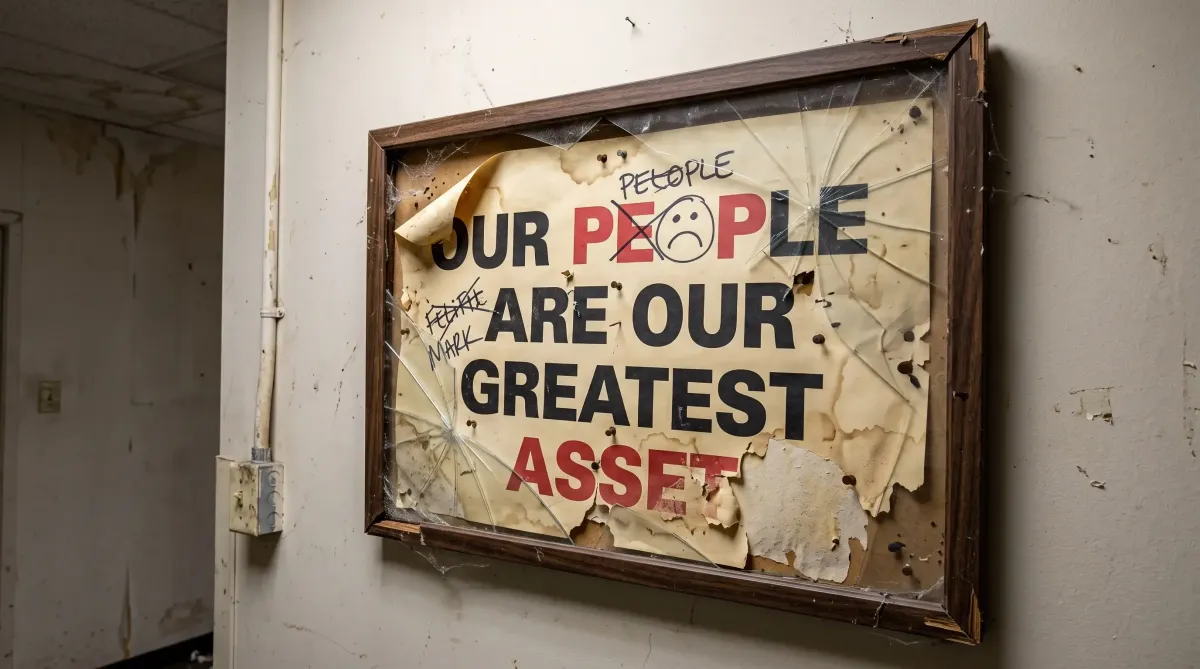
The Human Leverage Lie: Why "Our People Are Our Greatest Asset" Is the Biggest Fib in Business
You've said it. I've said it. Every founder on LinkedIn has said it.
"Our people are our greatest asset."
It's on the careers page. It's in the pitch deck. It's the first slide of the induction pack.
Here's the uncomfortable truth: your org chart doesn't believe you.
Look at how you actually structure people management as you scale, and you'll see something different. Not an asset. A liability you're managing. A risk you're mitigating. A cost you're containing.
That's not malice. It's structural drift. And it happens in four predictable stages, each one quietly adding to a debt you'll eventually have to repay with interest.
The Four-Stage Detour
Stage 0 (0-25 people): The Migraine
At this size, you are HR. Every hire, every awkward conversation, every "why don't they just do it like I do" moment lands on your desk.
The pain gets loud enough that you outsource it. A fractional HR consultant arrives, not to build leaders, but to write watertight contracts and handle dismissals without a tribunal claim.
The lens is set here, early and quietly: HR equals conflict management, not capability building.
Growth Coach Tip: The habits you build managing your first 10 people become the operating system for your next 90. Fix the system, not just the symptom.
Stage 1 (~25 people): The Admin Shield
Pain reaches a tipping point. You hire your first HR generalist, expecting the people problems to disappear.
They don't. They just get filed. Onboarding paperwork, leave requests, policy documents. Necessary, but it's plumbing, not leadership development.
Your managers still don't know how to have a hard conversation. HR just becomes the department that writes down the rules nobody enforces.
Stage 2 (~100 people): The CFO's Shadow
Now HR reports into Finance. Sensible on paper. Fatal in practice.
The moment people strategy sits under budget spreadsheets, the language changes. Cost-per-hire. Benefit spend. Headcount discipline. All useful metrics. All the wrong lens.
The message that reaches every desk in the building, whether you intend it or not: you are a cost to be optimised, not a capability to be grown.
This is where cash-is-oxygen thinking, correctly applied to your P&L, gets wrongly applied to your people. Profit before revenue is a discipline. Treating your leadership pipeline like a cost centre is a mistake.
Stage 3 (250+ people): The Resuscitation
Engagement drops. Your best people leave, not for money, but because their manager never learned how to manage. Culture starts to feel bureaucratic rather than alive.
So you hire a CHRO to "fix the culture."
Here's the tragedy. They don't spend year one innovating. They spend it doing structural repair, unwinding three stages of workarounds, distrust, and untrained managers.
Think of it like technical debt. Every shortcut you took on leadership and alignment early on gets logged. Someone eventually pays it off, usually at a much higher interest rate than if you'd invested upfront.
The Hidden Cost
This isn't an HR problem. It's a growth ceiling.
Businesses grow when people grow. If your operational structure is quietly training people to see themselves as line items, don't be surprised when they stop bringing you their best thinking.
Rockefeller didn't scale Standard Oil by treating his refinery managers as costs to be contained. He built layers of capable operators who could run their piece of the business without him breathing down their neck. That's not a nice-to-have. That's the entire mechanism of scale.
Here's my benchmark for a business that's actually ready to grow beyond its founder: within 12 months, your leadership team should be making 90% of operational decisions without you in the room. If your people function is stuck in defensive mode, that number will always sit near zero, because nobody's been trained, trusted, or held accountable to decide anything.
Defensive HR vs Offensive HR
Defensive HR manages compliance and contains cost. It's a fire extinguisher. Necessary, reactive, always one step behind the fire.
Offensive HR multiplies capability. It's a training ground. Proactive, deliberate, building the leadership bench before you need it.
Most businesses build the fire extinguisher first and never get round to the training ground. That's the detour. That's the debt.
Building Leverage from Day One
You don't need 250 people before human leverage matters. You need it from your fifth hire.
That means:
Right people, right seats, decisively managed. Not "we'll deal with it eventually." Deal with it in the next 30 days.
Leading indicators, not lagging regret. Engagement scores and manager 1-2-1 cadence tell you where the fire's about to start, not just where it already has.
Accountability that isn't optional. If nobody owns the outcome, nobody delivers it.
Real Communication. Creating psychological safety and trust. Building emotional connection and deeper bonds. High performing teams communicate, these are the foundations.
None of this is about warmth for warmth's sake. It's about building an engine where capability compounds instead of leaking away every time someone senior walks out the door.
I've made this mistake myself. I once let a "people problem" simmer for four months because I told myself I was too busy building the business to deal with it. The business I was building was quietly getting weaker every single week I avoided that conversation.
The Question Worth Sitting With
If your HR function vanished tomorrow, would your managers know how to run a hard conversation, develop a successor, or coach a struggling performer without a policy document to hide behind?
If the honest answer is no, you haven't got a people problem. You've got a leverage problem, and it started a lot earlier than you think.
Where is your business right now on the four-stage detour, and what's it costing you to stay there?